Monday, June 25, 2012

Dragon of the Mekong

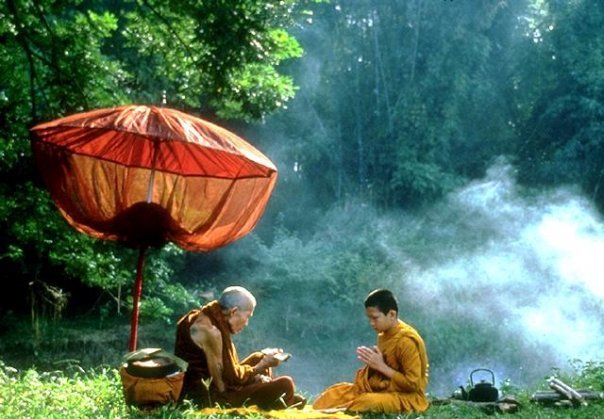
When I visited Ubon Ratchatani, I stayed at Wat Kitivaro, a huge enclosed forest monastery; a shabby, unkempt, run down monastery. A pack of 20 half-feral dogs ran free-reign throughout the grounds, on friendly terms with the local monks, but aggressive towards visitors like me. I was on my constant guard against being attacked by the dogs when no local monk was present to fend them off.

Huge coconut trees, nearly fifty-feet tall, reach into the blue tropical skies above the monks’ wooden huts.

Venerable Siripunno, an old monk who was a student of the famous teacher Ajahn Fan, lived in a small hut near the back of the wooded temple compound. He had been a monk for 42 years, ordained in 1967.

Delighted to have a chance to practice his English skills, he came to talk to me several evenings during my stay in the monastery. He had learned to speak English when he was a boy, through his interactions with the American GIs stationed in Ubon Air Base, where he worked small jobs. He still feels affection for Americans, and nostalgia for his boyhood memories.

I asked him if the local people actually believe in the Naga, the Mekong River dragon. “The Mekong River is a Nine Headed Dragon,” Venerable Siripunno said. “The people do believe in the Mekong River naga. It has scales like a fish, rather than skin like a snake or eel.”

“The naga is crowned or horned,” he said. “It moves through the later like an eel.”

He demonstrated for me, in hand motions, how nagas move through the water.

How to understand this assertion of dragons as real; as a matter of fact?

I recalled Karl Jung’s statement that there are many things in this world that we don’t understand: “Rationalism and doctrinarism are the disease of our time. They pretend to have all the answers. But a great deal will yet be discovered which our present limited view would have ruled out as impossible. Our concept of space and time have only approximate validity.”

In the year 2000, the journalist Richard Freeman led an expedition to Thailand in search of the mythical Mekong River Dragon – the naga. The expedition was commissioned by Discovery Channel.

“The Naga is essentially a gigantic snake, usually found in Hindu and Buddhist mythology,” Freeman said. “It is supposed to bear an erectile crest on its head rather like that of a cockatoo, but made of scales, which it holds menacingly aloft when angry, just as a cobra opens its hood.”

“Legend says the nagas possess immense intelligence and magical powers. They can, for instance, transform themselves into humans and walk unnoticed in the world of men. It is believed they inhabit grand underwater palaces, rather like the dragons of China…the naga is not satisfied with being a legend and still rears its scaly head, being sighted up and down the Mekong River even today.”

Freeman interviewed a 70 year old man named Pimpa, who claimed to have had a personal, terrifying encountered a naga. Pimpa lived in “an extremely remote village in the forested hills”, where he came face-to-face with a dragon while exploring some underground caves, connected to the Mekong.

Freeman followed Mr. Pimpa into the caves into the naga’s lair, for about a mile into the narrow, dank, labyrinth of tunnels.

“The old man had been exploring by candlelight when he turned into the cave and came across a giant snake. Its head was in the shadows, but the visible portion of its body was 60-ft long. Mr. Pimpa had pressed himself against the wall in terror as the giant reptile crawled past at an astoundingly slow pace. Its scales were black with glossy green sheen, and it was around 2.5 to 3-feet thick. Finally, it had disappeared along the passage, and Mr. Pimpa had collapsed gasping in relief.”

Freeman tried to give a rational explanation to the persistent, unshakable belief  in the existence of the naga among the people who live along the Mekong River. “There was once a group of primarily aquatic snakes which reached immense sizes. The Madtsoids…were found worldwide…Reports from all over the tropics suggest that some species may have survived to the present day. As well as their great size, all these monster snakes seem to share strange ornamentation on their head. The manotauro or sucuriju gigante of the Amazon is believed to have horns, and Indochina’s naga has a crest. Horns are not unknown on snakes; the rhinoceros viper of Africa and the horned viper of the Middle East are just two examples. Although their horns are actually modified snakes.”

The Mekong River forests of Burma, China, Laos, Cambodia and Thailand is one of the most vast and unique regions of the earth, bounding in life, surpassing the richness and diversity of the Amazon Rain forest.

In early 2009, the World Wildlife Fund released studies that identified thousands of new species previously unknown, including spectacular insects, reptiles, amphibians, and mammals. Perhaps they’ll find a naga.

Personally, I’ll suspend judgment. There are things in this world that we don’t understand.

“You must go visit my home place in Nakon Phanom,” Venerable Siripunno  told me. “You must visit vipassana center Wat Sitep. It is the best place, the best teacher – Chao Khun Tep, long time ago.”

He described the beauty of his homeland to me, the forest and scenery of flora and fauna along the Mekong River. A look of longing and joy came over his face as he remembered the distant scenes of the beautiful mountain-scapes of Laos, across the Mekong River, standing against the eastern horizon.
               
***

“The Mekong River is a nine-headed dragon,” Venerable Siripunno said.

The Mekong River is the realm of Sisattanag (Seven Headed Dragon). The That Phanom Chronicle says the Mekong River was dug by the naga -- literally River-dug-by-the-chest-of-a-naga -- when Indra cast him from Nong Sae, somewhere in southern China.

Many naga serpent-dragons followed, came to live in his realm, Suvannaphumi – the Land of Gold.

The Mekong is not a border, but is rather a central artery to the forest tradition of Theravada Buddhism.

When you see the Mekong, you feel the presence of the naga and spirits. You know for sure you’re in paradise. Bewitched, led by the spirit of the Mekong, by a mystery of the beauty of the place, you sense the real presence of the spirits, and realize the actual magic.

Such a beautiful world, so strongly seductive that one simply cannot leave it without sadness. There is something about the Mekong which, even years later, makes you want to sit down beside it and watch our whole life go by, writers waxed poetic under its spell.

The Mekong River is alive. It is the Dharma River. You will be actually enchanted, and commune with the spirit of the Mekong. It is a presence and mystery, and it will flow through you, as it spreads out into ‘nine heads’ of the Mekong Delta, and empty in the jade-green waters of the South China Sea.

The naga is protector of the Buddha.

Thursday, June 21, 2012

Future Ain't What it Used to Be

I talked to an old hippie girl on the metro bus
today
She was over 65 years old, living in senior housing 
Eyes still sparkled, though she was
     gray haired, wrinkled and fat.

"When I was young, I hated to hear
the old people complain about 'the 
    world today' - how bad everything 
    is, how good things were in the
    past; how everything gets worse 
    and worse. 

I promised that when
    I got old, I would not complain
    about 'the kids today' - how things
    are worse than they used to be.

But that's a promise I can't keep.

The world has gone wrong. People
are worse than they were before.
We are about the destroy the earth.
Horrible things are happening now - 
caused by human greed -  that
I could have never dreamed of.
The  world is on 
the wrong path,"
    she said.

Tuesday, June 19, 2012

Tintern Abbey ruins - temple of nature

King Henry the Eighth closed down all the monasteries of England and banished or killed the monks. Tintern Abbey, a Cisterican monastery, stood abandoned for three hundered years, overgrown with creepers and forest, a haunt of wild animals, when the young boy William Wordsworth came upon the ruins in the early 18th century. As the contemplated the ruins, Wordsworth was overcome with a feeling of enchantment and longing, that gave rise to the so-called “Romantic Movement.”

I regard the Romantic Movement as the first faint, pre-dawn glow of Buddhism in the West, in reaction to the scientific-rationalism of the 17th century.

Wordsworth saw the ruins of Tintern and was fascinated, mesmerized by the atmosphere and the effect it had on him. This feeling became the “romantic” feeling of longing for something that had been lost or forgotten, longing for another kind of world, a better and more humane world than the modern world he saw emerging around him.

Wordsworth intended to write a long philosophical poem called The Recluse, as a meditation on nature. The poem was never completed.

The poem “Lines composed a few miles above Tintern Abbey” outline his ideas on nature, as he contemplated the ruins of the Abbey overgrown in vines.

How do I trace Romanticism to the influence of Buddha?

As a young man, Wordsworth had come under the influence of the eccentric ideas of a wandering yogi, John “Walking” Stewart (Feb 19, 1747-Feb 20, 1822). Walking Stewart was an English eccentric, traveler, philosopher who had walked on foot form Madras, India (where he worked for the East India Company) back to Europe between 1765 and mid-1790’s. In his wandering life, he walked across Persia, Abyssinia, Arabia and Africa, before finally wandering through Europe and into Russia.

When he settled down in England, Walking Stewart wrote The Apocalypse of Nature (The Revelation of Nature) in 1794 and Opum Maximum in 1803, outlining his ideas that he had discovered of eastern spirituality. Walking Stewart had a philosophy which combined elements of Spinoza pantheism with yogic notions of the single unified consciousness, i.e. universal mind or Buddha nature. He began to publish his ideas in 179s with his book Travels over the most interesting parts of the globe.

Walking Stewart saw a conscious universe in which all parts interpenetrated and corresponded through vitalist energies, sympathies, and antipathies – which Buddhist call Interbeing. His books and speeches stimulated radical interest in Pythagorean and Brahminical ideas in Europe. We would think of him as  a “man ahead of his time.”  He was a feminist, animal rights activist, and also promoted ideas of vegetarianism.

Walking Stewart was appalled by violence, and insisted that “men must do no violence to any part of the animal nature.” He was opposed to slavery, and killing of animals, and capital punishment.

Walking Stewart said that men “have glutted on the Tree of Knowledge, on arts and sciences, and abandoned the Tree of Life, that is, the knowledge of the Self in the law of sensation, and the relations of men with all their surrounding nature.”

In his teaching in England, he aimed to “harmonize” men with the “great organism of their universe,” and he defined nature as the state “when appropriation of things and persons shall cease.”

When Wordsworth saw the ruins of Tintern Abbey, the vision seemed to trigger a recognition of something for which there were no words. He sensed "something", a message from another world, outside the modern world. He saw the Interbeing with nature that Walking Stewart had spoken of.

Tintern Abbey, suppressed by King Henry VII in 1536, had been deserted for nearly 250 years, when Wordsworth came across the runs overgrown with vines and abandoned in the remote forest wilderness.

The Anglican minister Reverenced William Gilpin was the first to discover the abandoned ruins, in modern times. He had published Observations on the River Wye in 1786, in which he had described the ruins; and he began a tourism industry, when English folks began visit the ruins in droves. Gilpin found the ruins “picturesque” – a word he coined and developed, meaning an “appreciation of nature that rolls through all things.”

The abbey ruins gave Wordsworth a pantheistic vision of the divine, nature. He is overcome with a “sense of the sublime of something far more deeply interfused, whose dwelling is the light of setting suns.”

He is met with the divine as “a notion and a spirit, that impels all thinking things, all objects of thought, and rolls through all things.”

The Romantic movement laid the foundation for Ralph Waldo Emerson and Henry David Thoreau and the American Transcendentalists, the “first Buddhists” in America. 

Saturday, June 9, 2012

The Good Life


.
The genius of the Buddha’s teaching is that inner peace is a transformative power in the world. We need inner peace to create social peace, and we must use Buddhist meditation to reach this inner peace. Personal transformation is the key for social transformation. Inner peace is the key to world peace.
            Buddha’s teachings are very easy. There is no need to make them complicated. You must do three things only: to refrain from evil; to do what is good; and to purify the mind. That is all.
            We must silence our minds, and listen inwardly until we can hear our own peaceful nature. When we hear our own inner peace, we will hear the peaceful nature of others as well. Wisdom comes from listening.
            The Dharma teaches us to know, shape, and free the mind. When the mind is mastered, all the dharma is mastered. What is the key for mastering the mind? It is mindfulness.
            All proceeds from mind, all we are arises from the mind. We are what we think. With the mind we create the world. Disorder and confusion in the world follows disorder and confusion in individual minds.
            Only with a change of within will there be a change without. Even if it is slow in following, it will never fail to arrive.
            Consciousness is the source of ethics. Our mind generates thoughts, speech, and actions. When we have a peaceful mind, we have peaceful words and deeds. We unfailingly start and return to one’s mental states. Some people see meditation as opposed to action, but the Buddha said meditation is the source of action.
            If you are mindful, you are a Buddha.
            Peace is like water flowing everywhere. Peacemaking is the proper response to violence. Non-violence brings peace. Peace is the highest happiness.
            Peace will triumph over war when people can walk down the streets with peace in their minds. That is the only step-by-step process that will bring an end to the great suffering of the people of the world.
            We must develop personal compassion as a gift to share, a gift of peace, a gift of healing.
            The act of walking itself must be made peaceful, then we will peacefully affect those we encounter.
            The Buddha called mindfulness ‘the only way.’ Always in the present. At this very moment. From moment to moment. In all activity. In this very step.
            Slowly, slowly, step by step. Each step is a meditation. Each step is a prayer. Each step builds a bridge to peace.
            It is the contemplative state of beings that we offer as a gift to the world. Our peace-offering can take the form of meditation, having tea with a refugee, being a peaceful person during business meetings, establishing an altruistic organization, or walking together in a peace vigil. The line between activism and other activities is erased with the correct mind-state.
            Responding to the present moment with loving-kindness, compassion, joy, and serenity is making peace.             We must live in the present moment. This. Here. Now. Every moment is a special moment. The present moment is the mother of the future. If we take care of the mother, the mother will take care of the child.
            So we must develop the right mind state, and respond to the present circumstances of our lives. We change the world primarily by our presence and our example.
            We are non-confrontational, non partisan. We simply tell the people to take care, be careful, be caring, be mindful and aware. It is difficult for people to see the harm they cause if they are not mindful. 
The most important action of a peacemaker is the be peaceful. We cannot be angry peacemakers.
We pray for peace all over the world.

Tuesday, November 22, 2011

Knowledge in Esoteric Khmer Buddhism


There are two kinds of knowledge distinguished by the Khmer: traditional knowledge and modern knowledge. The Cambodian tradtion, and Theravada in general, placed high value on ‘received knowledge’ rather than ‘speculative knowledge’ and ‘innovative knowledge’ so highly valued by the west.

Khmer tradition valued “knowing by heart” that emphasized memorization of text, meditation on the letters of the text. The texts were recited by heart by monks, and this is still a highly emphasized practice throughout Cambodian communities today. Traditionalists are critical of monks who cannot perform this service. The traditional practice of morning and evening chanting in honor of the Triple Gem, the Patimokh, are strictly observed. [Texts and prayers of such chants include: Kirimeanon, Girimananda; Eiseikili, Isigili; Mohasamay, Mahasamaya; Prumacak, Brahamacakka; Thoammacakka, Dhammacakka.]

What does it mean “to know” the text?

In traditional Khmer Buddhism, special status was associated with primarily meditative prowess which was understood to endow the monk-adept with extraordinary powers or iddhi.

They did not especially value the scholarly, intellectual, speculative knowledge valued by the west, and modernist educational reforms imposed by the French.

The French-inspired modernists emphasized rationalist, scriputralist, demythologized Buddhism. They deemphasized cosmological texts, particularly of the jatakas past lives of the Buddha.

The modernist reformers, following French scholarly traditions, reacted against the pedagogical tradition of rote memorization and recitation of texts, instead emphasizing the translation and interpretation of texts and sermons, between Pali and the vernacular, so that both monks and lay people not only took part in the performance of texts, but more importantly, understood the content of what was being read, preached and recited.

The new emphasis on scriptural Pali texts and monastic behavior, instead of the traditional emphasis on meditation practice and mystical attainment, provoked reaction from the “traditionalists” because it undermined the old values of the “folk,” the “people,” putting emphasis on formal monks.

It undermined the notions of sanctity associated with the older palm-leaf manuscript traditions that featured jatakas and abhidhamma, and yantra (tantra).

The old traditional forms of knowledge were based on Khmer language, the very script of which is sacred in itself to the Khmer tradition, allowing knowledge to plant seeds within the heart/mind, sprout, and grow.

The French introduced textual criticism and scholarship, and advocated a sort of  “pure” “original” Buddhism, as found in the Pali Text, promulgated by the Pali Text Society based in Sir Lanka. This movement created the impression of “uncovering a pure” Buddhism; and that het popular contemporary  Buddhism that the people found around them was “corrupted, decayed,” and therefore  needed to be reformed. The modernist reformers of elite, scholarly Buddhism ensued.

When Buddhist texts were translated from Pali into Khmer, the translators used the common language which stays closer to the ordinary speech, for the purposes of preaching. This indicates the populism of the Theravada movement in Cambodia; whereas the Buddhist reformers emphasized the “high” language for the purposes of scholarship or royalty.

Traditional Buddhism was interested in cosmography rather than psychology. They emphasized community rituals and practices for personal cultivation. The western-inspired modern reforms neglected the cosmological dimensions, and ritual aspects of Buddhism; and moved toward an emphasis on individual, rationality and morality.

The Theravada Buddhists of Cambodia attempted to accommodate modernism while preserving the essence of Buddhism. Their response to the pressure of modernity moved from the traditional interpretations to the modernist interpretations:
·         Cosmology > psychology
·         Community practice > individual practice
·         Jataka stories > academic scholarship
·         Merit making> meditation
·         Superstition> reason
·         Folk/populist>elite
·         Vernacular>Pali
·         Commentaries> suttas
***

Traditional Text Traditions

“Khmer texts were traditionally preserved either in palm-leaf manuscripts or accordion-style  folded paper manuscripts inscribed with ink or chalk. Since few opportunities for education existed outside the monastery, literary and writing were closely linked to religious practice. Writing in itself was highly valued and spiritually potent. Manuscripts were produced with great care, surrounded by rituals for preparing the palm leaves and ceremonies and regulations that had to be observed by monks who inscribed them. Finished manuscripts were consecrated, and the presentation of a manuscripts to a monastery required a ritual ceremony, such as the presentation of spread cloth for wrapping the texts or the donation of robes to the monk-scribe in order to effect the passing of merit to the donor of the manuscript. The quality and efficiency of the manuscript depended in part on the beauty of its written words, which in turn reflected the mindfulness of the monk who inscribed it, since in many cases, written syllables of the teachings were considered as microcosmic representations of Buddha. The production of the manuscript was thus an act of devotion whose quality could be judged according to its clarity, lack of writing errors, and aesthetic character. Imbued with these elements of the Buddha and the Dhamma, of merit and devotion manuscripts were venerated as aural texts, meant to be heard, conferring merit on their listeners and on the monks who read or chanted them, and as written texts, venerated in and of themselves for their written nature. Ideologically committed to new technologies of textual translation and print dissemination, modernists rejected these traditional methods associated with manuscript production as well as other older practices, ritual conventions, and ways of  transmitting  knowledge connected with the manuscript culture of learning.” [Hansen, How to Behave.]

Hansen describes the texts as a sort of talisman. “Khmer families, individuals, and monks who owned texts viewed them as sacred objects to be used and maintained for ritual and most important was that, in their minds, texts presented to temples were meant to generate merit: to remove texts donated for this purpose was unthinkable.”
This is why monks concealed the texts from non-Buddhist French colonialists. And also explains why they resisted so strongly the book-print culture imposed by the French and modernist monks.

“A monastery, like the kingdom, was better off – stronger and purer – if it possessed texts. A prevailing view of texts was of physically potent objects that affected the spiritual wellbeing of the individuals who handled them; their exact contents were of lesser importance. Texts were understood to be sacred in much the same way as relics, which embody physical elements of the Buddha. Being in physical proximity or contact with texts, touching them, seeing them, or hearing them, connected one with the Buddha and his teaching devotionally. These acts generated merit first, and led to greater intellectualized forms of understanding only as a secondary aim, if at all; rather, devotional acts generated a different kind of insight, more akin to meditational understanding…”

Penny Edwards said:”Due to their long-standing use as the tangible vehicles of Buddhist teachings or dhamma, palm-leaf manuscripts became objects of sacred power in their own right in the Buddhist societies of Southeast Asia.”

“The preparation, transfer, and maintenance of Buddhist manuscripts involved acts of consecration, dedication, and presentation centering on the notion of the manuscripts intrinsic and accumulated merit.”

Writing in and of itself was highly valued and spiritually potent…surrounded by rituals preparing palm leaves, and ceremonies and rituals had to be observed by the monks who inscribed them.

Esoteric Texts:

Khmer Buddhist writings are ritualistic and experimental rather that doctrinal, theoretical, didactic. They are esoteric, apparently “unorthodox” Theravada. They were designed to be taught under an adept. Francois Bizot “has revealed the existence of non -orthodox Buddhist meditational practices that have been largely secret.”

“The texts underpinning the tradition are often obscure, are clearly symbolic, and may be subjected to multiple interpretations. They have much to say about ritual and frequently contain mantras in Pali. The tradition is clearly old and certainly predates the reform movements of the nineteenth century.”

The Saddhavimala was in important Cambodian text studied by Bizot and Laguarde, a text which relates that the seven books of the Abhidhamma are the creative force behind the body and mind of all things. The oral recitation of the Abhidhamma is very powerful, particularly the Mahapatthana, the final work. Each of the seven books is connected with a day of the week and a part of the body.

Mahadibbamanta, an undated Pali-language palm leaf paritta text, inscribed in Khmer characters and probably of Cambodian origin, housed in the National Museum of Bangkok. The text represents tantric esotericism in Theravada tradition. “It consists of 108 verses, an auspicious number also mentioned in the work itself. One of the unusual features of the text is that it describes a mandala of the eight chief disciples of the Buddha. It also includes a mantra hulu, hulu, hulu sva ha and some verses of benediction (siddhi gatha) which glorify a range of deities, including the earth-goddess, the Buddha, Hara, Hirihara, and Rama and the nagas. The Mahadibbamanta manta equates the Buddha with various major and minor divinities and concludes with an assurance of the magical efficiency of the texts recitation, particularly in countering enemies…the work is not uncharacteristic of the Pali Theravada literature that had circulated in Cambodia for several centuries.” [Harris.]

The major traditional cosmological texts in Cambodia are the  familiar root texts of the boran (ancient practice):
·         Traiphum – the “Tree Worlds”. The text is a version was published in Phnom Penh by Japanese Sotasha Relief Committee in 1996 with an introduction by Michel Tranet.
·         Traiphet – a Khmer text dating with the origin of the world. It is a treatise dealing with Brahman legends
·         Traiyuk – is the three world stages (1st, 3rd, 4th).
·         Traita – is a treatise dealing with the second world stage
·         Traiwet.

“The arrival of the French and gradual imposition of the conditions of modernity on the Buddhist sangha had a profound impact on all aspects of Cambodian culture, particularly in the field of writing. Traditional literary activity was one of the immediate casualties, as monks turned away from the laborious and ritually circumscribed techniques associated with traditional manuscript production to adopt writing in European-style notebooks. In time, many turned to printing, and the old copyists craft with its merit-making underpinnings began a dramatic decline. In addition, an archaic and essentially magical vision of the universe, in which inscribed Khmer characters are assigned occult powers, was largely undermined….It is rare today to find monks who have any confidence in reading traditional cosmological works, such as the Traiphum, which once formed the core of the Khmer literary cannon.” [Harris.]

“The sacred physical and devotional  aspects of textuality  were in many respects diminished and altered with the transition to print culture that occurred during the 1920s…”

During the modern reforms of the 20th century, the modern textual criticism made a distinction between the physical text, and the authentic potency of understanding the authoritative meaning of the text, to order the conduct of the monk. This provided “purification” if understanding and conduct.

By 1929, the struggle between printed books and inscribed palm leaf was resolved, and printed books became more accepted. The “modernist” group became more ascendant in the Khmer Sangha. The new monks “modern dharma” shifted away from production of texts for entertainment/celebration purpose, performance, devotion, merit making, toward edification, education, instruction for ethical conduct, understanding of Buddha’s teaching (right view), and was concerned with accessibility.

As the scholastic Buddhism gained ascendency, the esoteric traditions receded into the background in Cambodia.

Sunday, November 20, 2011

Kammathana: Escoteric Meditation in Cambodian Buddhism


The yogi or yogavacara of Cambodia practiced the “hidden” (lak) or “interior way” (phluv knong). The yogavacara (esoteric or initiatory tradition of Cambodia) is a practitioner of yoga who becomes an adept of mula khammatthana (neak mula kammathana).

The modern monk-scholar practices the “exterior way” (pluv krau).

In mainstream Theravada Buddhism, the term khammathana refers to the 40 meditation subjects authorized by the Buddha. In Cambodian tradition, however, the term “khammatthana”  has a special meaning, the mastery of pluv knong. Khmer tantra operated with a theory of correspondences, letters, sounds, numbers, presented in a ritual context.
The term “mula” means the skill of using Khmer alphabet to denote Buddha’s teaching. Mula Kammatthan can be practiced in two ways: (A) the “right hand path” (phluv sdam) which leads to nibbana; (B) the “left hand path” (phluv chveng) which leads to attainment of worldly ends, such as gaining power over others.

“The work of the brah khammatthana  refer to the Tripitaka in ways different from the manner employed by the modernists. The traditionalists explain nothing. They hide (what they know) and teach how to practice the spiritual life…The modernists transmit their knowledge but only speak of fruits and flowers. Of roots and stumps they say nothing.” Acher Trok Din [Harris p.96]
***
When Acher Trok Din speaks of the “fruits and flowers, roots and stumps” he is referring to a Cambodian esoteric meditation tradition. Maha Ghosananda also spoke of “The Bodhi Tree” of the body. The Cambodian yogavacara tradition draws correspondences between the embryo and a “fig tree with five branches.”

The human body is the “tree” of transformation, the cosmos, and the Buddha’s teaching (Dhamma) is crystallized/expressed in sound.
·         Trunk = torso
·         Branches = arms and legs
·         Leaves = two ears
·         Flower = umbilicus
·         Fruit = embryo
·         Roots = penis and testicles (which give rise to future generations)

The fig tree has five branches, with its roots in the infernal regions, its branches reaching into the deva-realm.
The tree also represents the Dhamma: Fruits are the Tripitaka; Leaves, the ten perfections…etc…

Francois Bizot  referred to this tradition in his writing. This allegorical symbol represents the human body as the physical locus of transformation the cosmos, and it expresses and crystallizes the Buddha’s teachings (Dhamma) in the form of sound. “As the human body, its trunk is the torso, its branches are the arms and legs, its leaves the two ears, its flower the umbilicus, its fruit the embryo, and its threefold root is the penis and testicles, which give rise to future generations. The fig tree with five branches is also the world tree, stretching as high as the divine deva world, and its roots in the infernal regions. The system, then, homoligizes the macrocosmos to the human body. The tree is the world axis, or Mt. Sumeru, but ‘in the five aggregates of our bodily form, our head is Mt. Sumeru, our chest Mount Giri Parabat, our pelvis Mount Gijjhakuta Parabat (Vulture Peak), and two knees, the  two ankles, and the two soles, the seven levels of Mount Sattaparibhand, the enclosure of Mt Sumeru. The four lakes situated at the foot of Mt Sumeru are the four elements of our bodily form.” [Bizot 1976.]

“The tree also occurs in another allegory of the spiritual path. The twins Nan Cittakumara and Nor Cittakumari represent the spirit of yogavacara. [Nan Cittakumara and Nan Cittakumari represent respectively the mind (citta) and mental factors (cetasika). As such they also denote the psycho-physical being in the intermediate states between two existences.] They take leave of Yama, the god of death, to seek birth in the rose-apple land (Jambudvipa, India), but they get lost on the way. While they lament their predicament, a god in the form of a man encourages them to search for a jewel collected the birth globe (tuong kamnot), or a crystal globe (tuonhg kaev), hidden in a fig tree with five branches. The two children make supplication to the deity and begin their  quest. The crystal globe is guarded by Indriy birds (sense faculties), but its possession will confer great happiness, for it is in essence the three letters “ma,” “a,” and “u” which make up the sacred syllable “Om.” These three letters are also the “noble triple dhamma” (preah dhammatrai); they correspond to the three sections of Tripitaka. In other words, the twins must create a new body out of the elements of Buddha’s teaching. This new dhamma body (dhammakaya) is the key to Nibbana.

In some of his later writing Bizot sees parallels between this initiatory body and the Mahayana doctrine of the Tathagata (tathatatagarbha).

Kasina

Kasina meditation are part of the meditation tradition. The word kasina means “total field.” And includes the ten meditation on earth, water, wind, fire, blue, yellow, red, white, space (akasha) and consciousness (vijnana). In this process, the mind is exclusively, and with complete clarity, filled with the object and finally becomes one with it (Samadhi).

Samadhi is “unified mind” collected in a single object through gradual calming of mental activity. The consciousness of the subject becomes one with the object.

This state of consciousness is often called “one pointed concentration”; “this expression is misleading however, because it calls up the image of the mind “directed” at one point.

Samadhi is neither a straining concentration on one point, nor is the mind directed from here (subject) to there (object), which would be a dualistic experience. The ability to attain Samadhi is a precondition for absorption/jhana.

[Vipassana: the three super mundane types of Samadhi are distinguished that have as their goal emptiness, the state of no characteristics, and freedom from attachment to the object, and the attainment of Nibbana. Any other Samadhi, even in the highest stages of jhana, are considered worldly.]

Kasina meditations are associated with magical powers (iddhi) in Theravada Buddhism of Cambodia.
Cambodian Buddhism sees meditation practice in cosmological terms. Stanley Tambia describes the correlation/matrix of Buddhist cosmology and the meditation states. These are outlined in Visuddhimagga chapters 13 and 14. These practices develop the three-knowledges of “divine eye” and “passing and reappearance of things” to the periodic creation and dissolution of the cosmos and the world cycles of the eons of time.

Meditation ascends from rupa (material) to arupa (immaterial) states of consciousness: From access to neighborhood concentration, to absorption concentration, the first jhana.

Then the arupa/formless begins at fifth jhana of empty space. Iddhi-powers can come only after the 4th jhana.

The meditatior develops a spiritual potency, charismatic quality, or “magical power” known as saksit.

The forest monk, or traveling masters (lok thudong) attained potency (saksit) and knowledge (vijja), and were able to influence and benefit others.  The adept must have not only rational knowledge, but be attained, i.e. be transformed by that knowledge, be virtuous by observing the Buddhist precepts. The adept maintains balance between mind and external objects (equanimity, equilibrium). He is able to embody, incarnate, Enlightenment